Yellow W-Beam Guardrail
Also known as: yellow armco barrier, yellow crash barrier, yellow powder coated guardrail, RAL yellow w beam
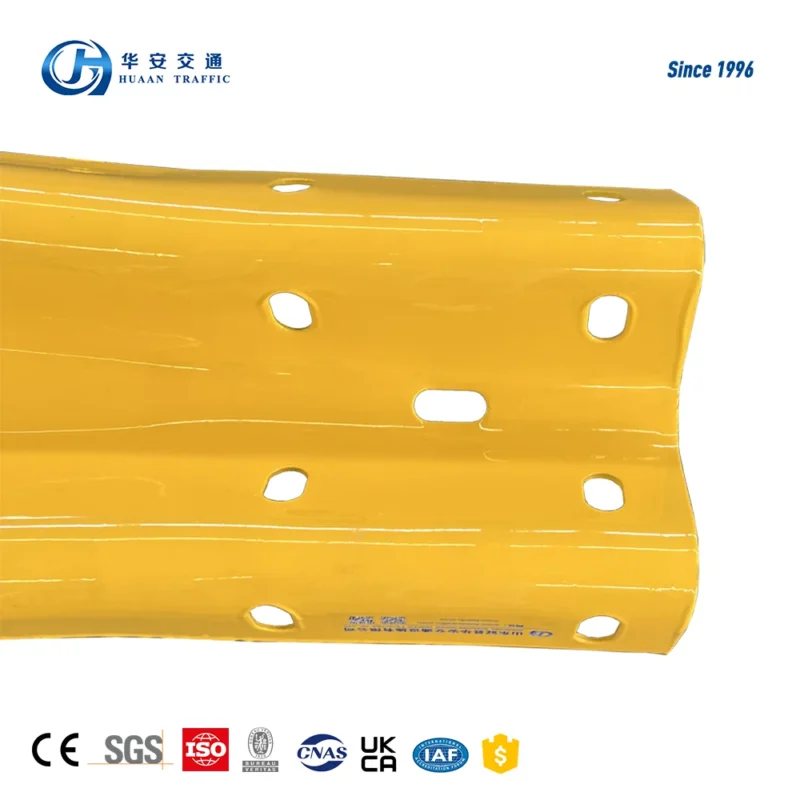
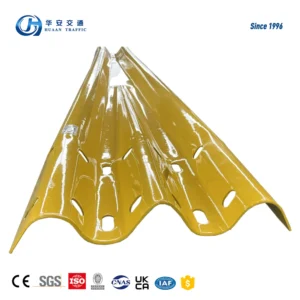
Two-wave W-beam in signal yellow: hot-dip galvanised first, then powder coated, so a chipped face still has zinc underneath. 3.0 / 4.0 mm, 4320 x 310 x 85 mm.
- Choose this when
- Tunnel portals, work-zone tapers and low-light urban sections, where the barrier has to be seen before it is reached.
- Choose another when
- Long rural and industrial runs, where there is nothing to signal and the duplex coating is paid for without being used — plain galvanising is the correct answer there.
- Profile
- Two-wave W-beam
- Rail size (L x W x H)
- 4320 x 310 x 85 mm (4000 mm effective); adjusting rails 2820 / 3320 / 3820 mm — custom sizes to drawing
- SampleSample available on request, freight at cost
- PaymentT/T, L/C at sight — terms confirmed on the quotation
- ShippingFOB / CIF from Qingdao or Tianjin
- Lead time5–20 days after drawing approval
Where it is used
Yellow earns its place where a driver meets the barrier at speed in poor light — tunnel approaches, temporary works and lit city corridors. The colour is the top coat of a duplex system: hot-dip galvanising first, polyester powder over it, so the corrosion layer and the colour are applied in one operation rather than two.
Why yellow here and not elsewhere
Signal yellow reads at distance in rain and at night under sodium light, which is why tunnel approaches and temporary works use it. On a long rural run there is nothing to signal, and the duplex coating is paid for without being used — plain galvanising is the correct answer there.
What the colour does not change
The section, the gauge and the bolt pattern are the same as the plain galvanised W-beam: 4320 x 310 x 85 mm, 3.0 or 4.0 mm, 8 x M16 per joint. What it does change is the maintenance story — a chipped face still has zinc under it, so a repair is a touch-up rather than a replacement.
Specification parameters
Beam dimensions
| Profile | Two-wave W-beam |
|---|---|
| Rail size (L x W x H) | 4320 x 310 x 85 mm (4000 mm effective); adjusting rails 2820 / 3320 / 3820 mm — custom sizes to drawing |
| Thickness | 3.0 / 4.0 mm — custom sizes to drawing |
| Mass per rail | approx. 49.2 kg (3.0 mm) / 65.6 kg (4.0 mm), before coating |
| Splice | 8 x M16 bolts per joint |
Colour and coating
| Colour | Yellow, one colour per order. RAL 1003 signal or RAL 1023 traffic to order — state the RAL number on the drawing |
|---|---|
| Coating build | Duplex: hot-dip galvanised 550 / 610 g/m2 both faces (= 275 / 305 g/m2 per side), then polyester powder |
| Powder thickness | 60 - 120 um single coat; 80 um minimum for exterior exposure — custom sizes to drawing |
| Colour scope | Rails, posts, blockouts and bolt heads coated in the same batch so the run reads as one colour |
What the colour does and does not change
| On impact | A paint film chips to bare steel and rust starts at the chip; here the zinc is under the powder and keeps working after the face is broken |
|---|---|
| Unchanged by colour | Section, gauge and bolt pattern are the same as the plain galvanised W-beam |
Supply
| Steel grade | Q235B (S235JR) |
|---|---|
| Supply form | Set: rail, post, blockout and bolt kit, in matching yellow |
| Matching post | Round 114 x 4.5 mm, or C-section 150 x 75 x 4.5 mm — custom sizes to drawing |
| Typical use | Tunnel portals, work-zone tapers, low-light urban corridors |
Frequently asked questions
Why yellow rather than green or blue?
Yellow reads at distance in rain and under sodium light. Green and blue are specified where the barrier has to sit quietly in a landscape; yellow is specified where it has to be seen before it is hit.
Does the colour survive a hit?
The face coating will chip, but the zinc underneath is still there. That is why the powder goes over hot-dip galvanising rather than over bare steel.
Can posts and bolts match?
Yes. Rails, posts, blockouts and bolt heads are coated in the same batch.
What do I put on the drawing?
The RAL number, the powder thickness (80 um minimum for exterior) and the zinc weight. Colour alone does not define the corrosion layer.