
Crash Cushion
Redirective and non-redirective impact attenuators for gore areas, toll plazas and bridge piers.
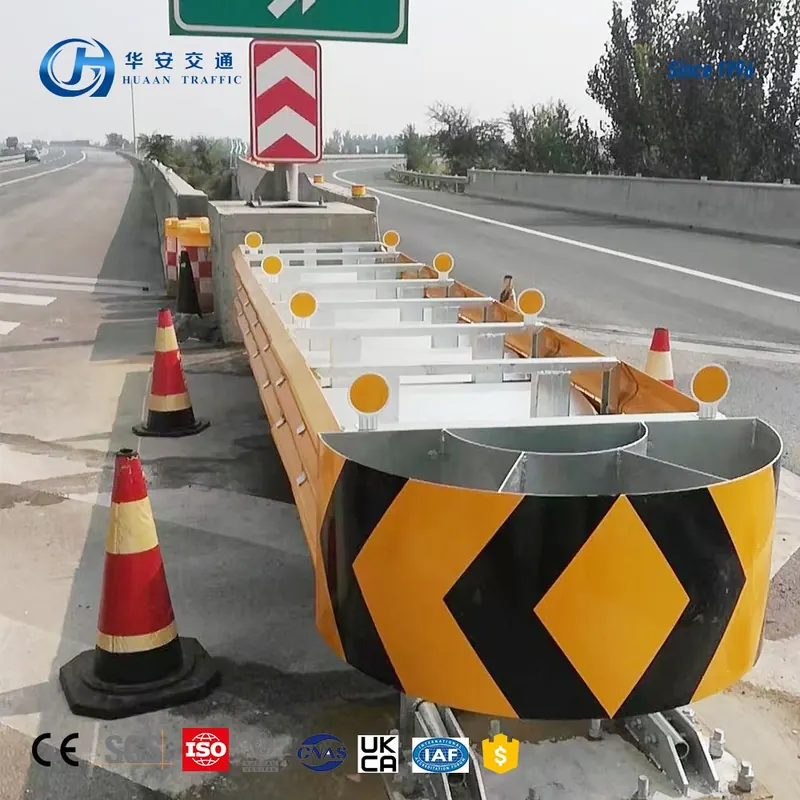
Redirective Crash Cushion
Redirective crash cushion for toll plaza noses and gore areas. Steel shell, anchored base, cartridges replaceable after impact. Selected by hazard width.
Water-Filled Crash Cushion
Water-filled crash cushion for temporary works and low-speed hazards. Yellow and black shell with reflective banding, ballasted on site, relocatable.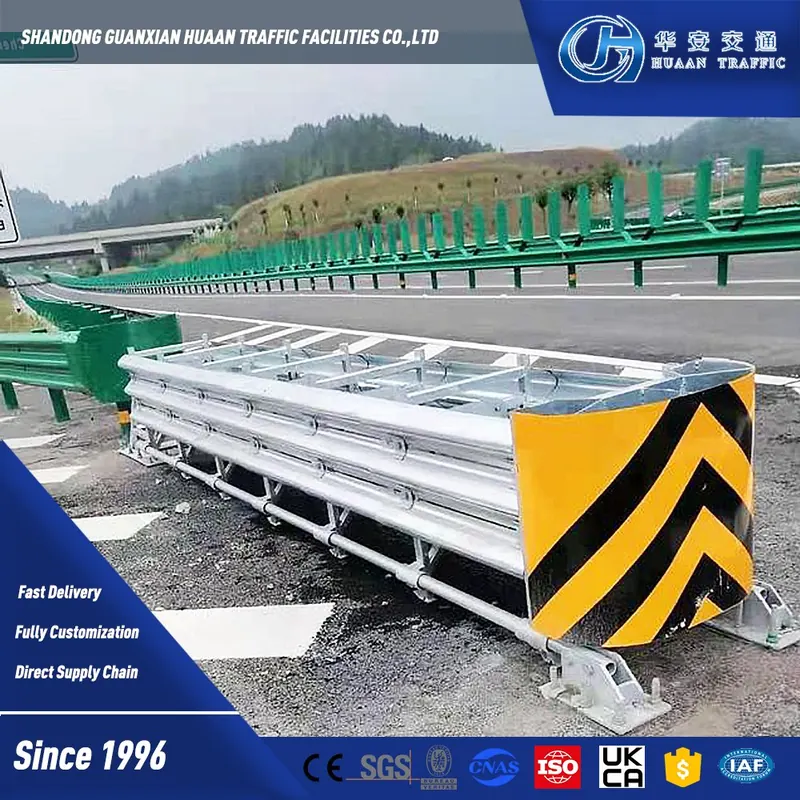
Energy-Absorbing Crash Cushion
Energy-absorbing attenuator for bridge piers and rigid hazards. Selected against the hazard width, the available run-up length and the design speed.Specification parameters
1. Product Range
| Redirective, non-gating cushion | Crushable energy-absorbing cartridges inside a telescoping steel frame; redirects side impacts back toward the original path |
|---|---|
| Water-filled cushion (non-redirective) | Sacrificial plastic modules filled with water; anchorless; for permanent and work-zone locations |
| Steel-frame energy-absorbing cushion | Steel attenuator supplied in TB / TA / TS grades (60 / 80 / 100 km/h) |
| Transitions | Connect the cushion to the barrier or hazard it shields; many barrier profiles covered |
2. Dimensions
| Water-filled module weight | Approx. 50 kg empty |
|---|---|
| Customisation | Other lengths and widths made to drawing (steel-frame type) |
3. Material & Surface Treatment
| Steel grade | Q235B / Q355B (≈ S235JR / S355JR) |
|---|---|
| Steel thickness | 2.67 – 4.0 mm (steel-frame type) |
| Finish | Hot-dip galvanizing (550 g/m² minimum single-spot); powder / plastic spray coating |
| Color | Zinc-silver or traffic yellow; other colors on request |
| Water-filled modules | Polyethylene shell; no internal steel parts, so approved anti-icing chemicals may be added |
4. Standards
| Europe | EN 1317-3 (crash cushions) |
|---|---|
| USA | AASHTO MASH (superseding NCHRP Report 350) |
| Australia / New Zealand | AS/NZS 3845.2:2017 (road safety devices) |
| China | JTG B05-01-2013 (evaluation), JTG D81-2017 (design) |
5. Performance Classes (as defined by the standard)
| EN 1317-3 test vehicles | 900 kg, 1300 kg and 1500 kg cars; frontal, offset, angled and side approaches |
|---|---|
| EN 1317-3 cushion types | Redirective (contains and redirects) and non-redirective (contains, does not redirect) |
| EN 1317-3 impact severity | Class A: ASI ≤ 1.0; Class B: ASI ≤ 1.4 |
| EN 1317-3 lateral displacement | Classes D1 – D8 (0.5 / 1.0 / 2.0 / 3.0 m) |
| EN 1317-3 redirection zone | Classes Z1 – Z4 (4.0 / 6.0 m) |
| MASH (USA) | TL-1 50 km/h, TL-2 70 km/h, TL-3 100 km/h; 1100 kg car and 2270 kg pickup; TL-3 is the highest level for crash cushions |
| JTG B05-01-2013 (China) | TB 60 km/h, TA 80 km/h, TS 100 km/h |
6. Installation
| Redirective cushion | Anchored to a concrete pad or deck; relocatable versions on a monorail base |
|---|---|
| Water-filled cushion | No ground anchoring or foundation; deployed on almost any road surface and pinned to the barrier end |
| After impact | Redirective: cartridges replaced, frame largely reusable. Water-filled: impacted modules replaced; nose and transition reusable after most design impacts |
7. Applications
| Diverge noses | Mainline and ramp diversion ends |
|---|---|
| Tunnels | Tunnel entrances and exits |
| Toll plazas | Ends of toll booth islands |
| Bridges | Middle piers of overpasses |
| Work zones | Temporary hazard shielding |