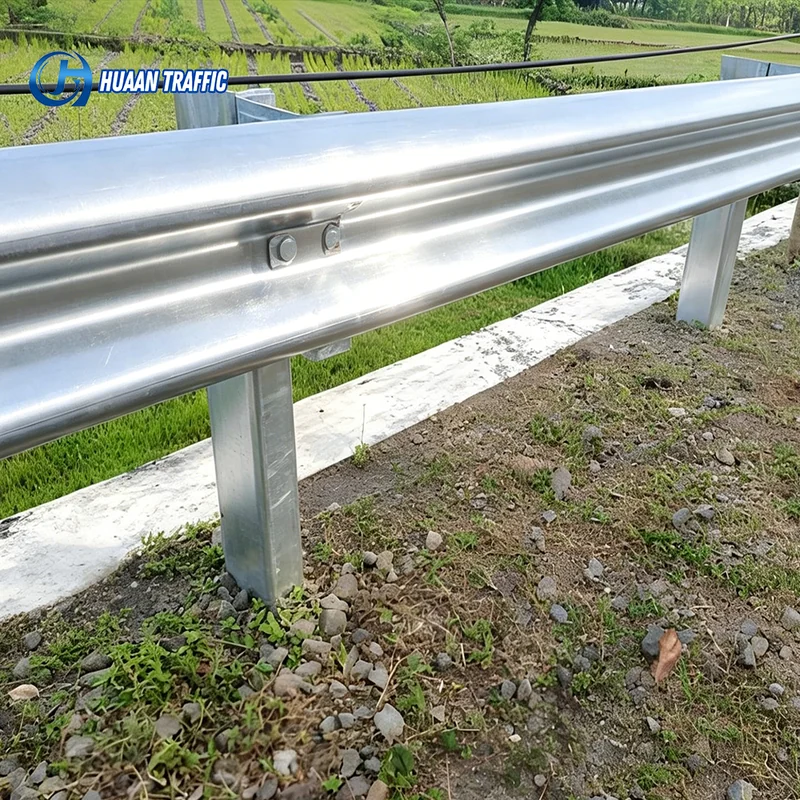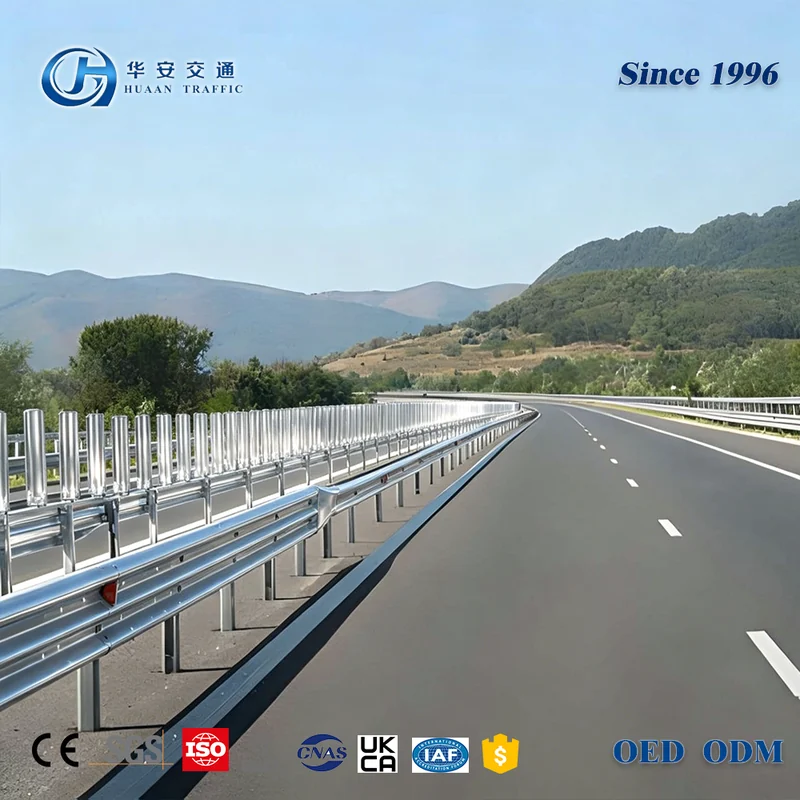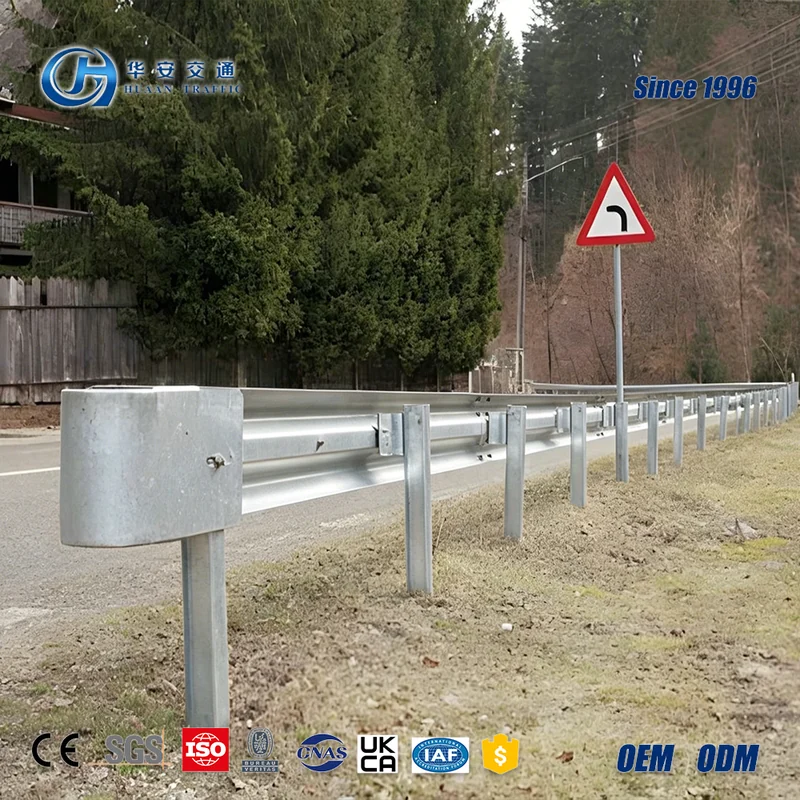
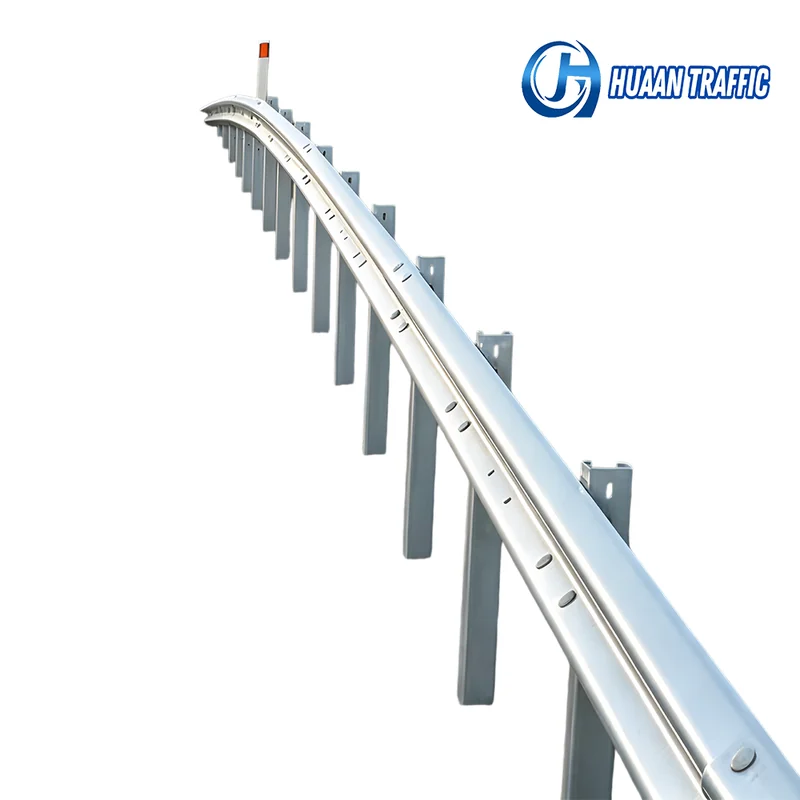
AASHTO M 180 grades the beam, not the barrier. That single fact explains most of the confusion around Class A and Class B: the classes describe the thickness of the steel, while most of what decides how a run behaves is chosen elsewhere — the posts, the spacing, and the zinc type.
Two classes on one profile
Class A is 2.67 mm (0.105 in) and Class B is 3.43 mm (0.135 in) [1]. Both are formed on the same 312 x 83 mm two-wave profile, both take eight bolts at the splice, and both are supplied at 3,810 mm effective length, which is 12 ft 6 in. Nothing about the shape changes between them; only the plate does.
| Property | Class A | Class B |
|---|---|---|
| Sheet thickness | 2.67 mm (0.105 in) | 3.43 mm (0.135 in) |
| Profile | 312 x 83 mm | 312 x 83 mm |
| Splice | 8 bolts | 8 bolts |
| Zinc type | Type I or Type II | Type I or Type II |
What the class actually changes
Three things, and only three. The mass per metre of the rail, which moves the price and the freight. The bending stiffness of the beam itself, which is what allows a longer post spacing or a higher containment level to be reached with the same profile. And the drawing the factory works to, because Class A and Class B are separate orders with separate sheet.
Everything else on the barrier is still to be specified: post section, spacing, embedment or base plate, blockout depth, end treatment and coating. A quotation that answers “Class B” and nothing else has answered one question out of seven.
Zinc type is a separate decision
M 180 also defines the coating, and it is graded independently of the class: Type I at 550 g/m2 and Type II at 1,100 g/m2, both faces [1]. A Class A beam with Type II zinc is a perfectly normal order, and so is a Class B with Type I. The choice follows exposure and design life, not thickness.
This matters when comparing quotations. Two suppliers can both quote “Class B” at different prices and one is quoting Type I against the other’s Type II. The zinc figure belongs in the same line as the class, always.
Which one for which road
Class A is the lighter beam and is used where the specification allows it: lower-speed roads, secondary routes, access and estate roads, and stretches where the posts can be set closely enough to carry the lighter plate. Class B is used where more is asked of the beam — higher containment, longer post spacing, or a standard that simply names it for the road class.
That decision belongs to the road authority’s standard, not to the buyer. A supplier who upgrades a Class A drawing to Class B “for safety” has changed the order rather than improved it, and the quotation no longer matches the drawing it was asked to price.
Why Class B is not a free upgrade
- It is a different drawing. The sheet thickness changes the mass per metre, the handling and the freight, and those are priced.
- It does not raise the class on its own. Containment is a property of the installed system; a heavier beam on the same posts does not automatically deliver more.
- It breaks comparison. Once one supplier quotes Class B against a Class A drawing, every other quotation for that job is being compared against the wrong number.
M 180 against EN 1317: different objects
M 180 grades a beam. EN 1317 grades a system. That is the whole difference, and it is why the two do not convert.
A Class A beam at 2.67 mm is not “about 3.0 mm metric” and it is not a lower grade of an EN 1317 class. A metric 3.0 mm W-beam is an ordinary EN-order beam, and a Class A beam is an M 180 order; the plate, the length and the hole pattern are all different, and the two are not interchangeable on a drawing that names one of them. If you are working to EN 1317 rather than M 180, the equivalent reading is on EN 1317 Containment Levels.
Where to specify each
The AASHTO M 180 Class A page carries the 2.67 mm order in full. The 3.0 / 4.0 mm metric beam, which is a different product, is on W-Beam Guardrail. Where the specification names a containment class rather than a gauge, the order belongs on the Armco barrier page.
What to put on a drawing
- M 180 as the governing standard, and the class — A or B.
- Zinc type — I or II — stated separately from the class.
- Post profile and spacing, since the class does not fix them.
- End treatment, and the coating colour if the run is coated.
References
[1] AASHTO M 180, Standard Specification for Corrugated Sheet Steel Beams for Highway Guardrail — Class A 2.67 mm (0.105 in), Class B 3.43 mm (0.135 in); Type I 550 g/m2, Type II 1,100 g/m2.